

崔松岿 男 博士生导师
中国科学院昆明植物研究所
电子邮件: cuisongkui@mail.kib.ac.cn
通信地址: 昆明市蓝黑路132号中国科学院昆明植物研究所
邮政编码: 650002
研究领域
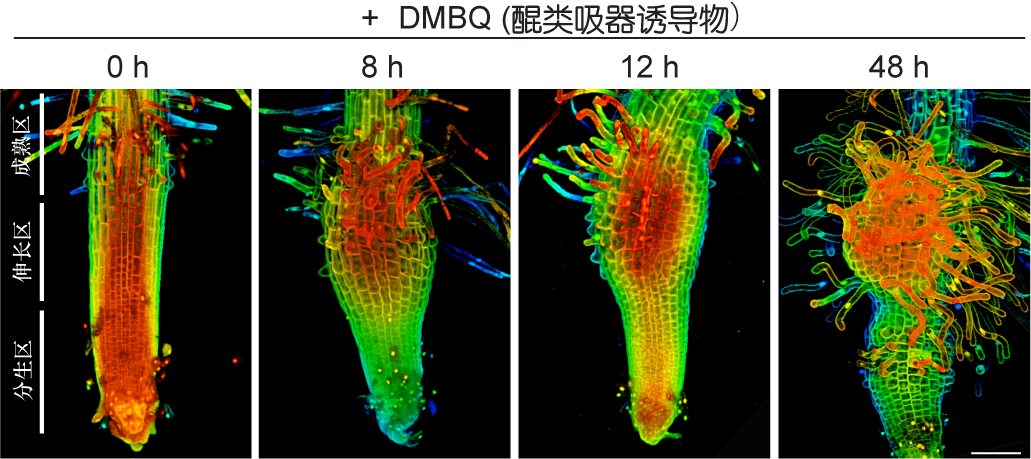
一. 寄生植物吸器产生的分子机制 【根际信号互作】
通过研究模式寄生植物松蒿(Phtheirospermum japonicum)的突变体,阐明寄生植物如何感知并传导源于寄主的信号物质(醌,酚,类黄酮),继而诱导吸器。
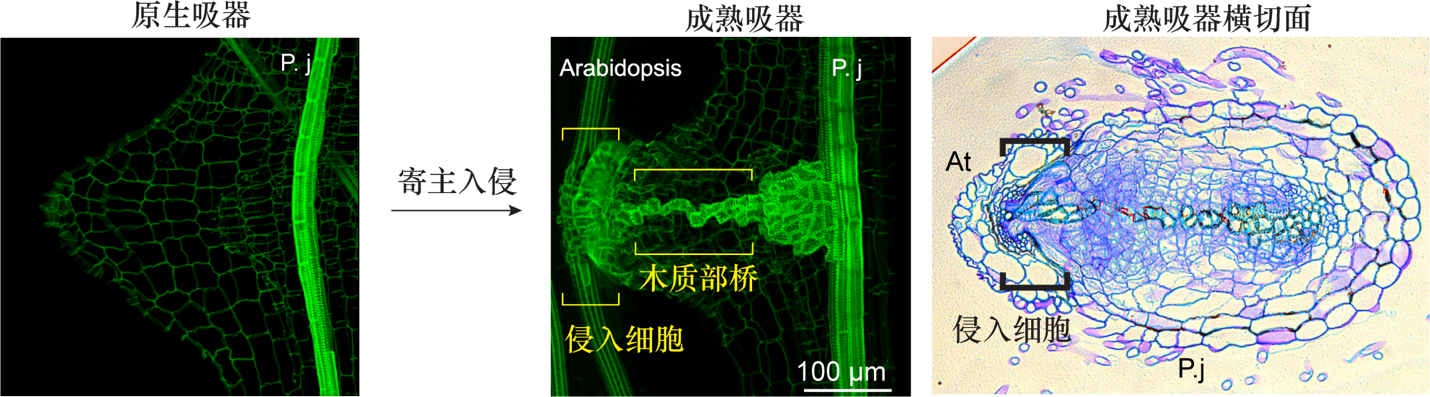
二. 吸器侵入其他植物组织的分子机制 【细胞间信号互作】
结合活体成像技术,研究吸器侵入寄主时表皮细胞分化为侵入细胞的分子机制,以及侵入细胞的生理特征和功能。
三. 植物对抗寄生植物的防御机制
自然界中一些植物对寄生植物具有抗性,利用多种通道防止寄生植物对其生长带来的抑制作用。在这些非易感植物中,通过鉴定抗性基因解析抗寄生植物与寄生植物间的非亲和机制。
招生信息
招生专业
招生方向
教育背景
2003-09--2007-07 哈尔滨工业大学 学士学位
学历
博士研究生(日本综合研究大学院大学国立基础生物学研究所NIBB)
学位
细胞生物学博士(日本综合研究大学院大学国立基础生物学研究所NIBB)
工作经历
工作简历
2021-01~2022-09,日本奈良先端科学技术大学院大学, 助教
2019-04~2020-12,日本奈良先端科学技术大学院大学, 特任助教
2016-04~2019-03,日本奈良先端科学技术大学院大学, 博士后
2013-08~2016-03,日本理化学研究所, 博士后
2013-04~2013-07,日本综合研究大学院大学国立基础生物学研究所, 实习研究员
专利与奖励
奖励信息
(2) 科学图像奖, 一等奖, 国家级, 2016
(3) 国际寄生植物会议最佳发表奖, 一等奖, 其他, 2015
(4) 综合研究大学院大学院长授予奖, 一等奖, 研究所(学校), 2011
出版信息
发表论文
[2] Songkui Cui, Shoko Inaba, Takuya Suzaki, Satoko Yoshida. Developing for nutrient uptake: induced organogenesis in parasitic plants and root nodule symbiosis. CURRENT OPINION IN PLANT BIOLOGY[J]. 2023, 第 1 作者null(null): http://dx.doi.org/10.1016/j.pbi.2023.102473.
[3] Aoki, Natsumi, Cui, Songkui, Ito, Chiharu, Kumaishi, Kie, Kobori, Shungo, Ichihashi, Yasunori, Yoshida, Satoko. Phenolic signals for prehaustorium formation in Striga hermonthica. FRONTIERS IN PLANT SCIENCE[J]. 2022, 第 2 作者13: http://dx.doi.org/10.3389/fpls.2022.1077996.
[4] Ogawa, Satoshi, Cui, Songkui, White, Alexandra R F, Nelson, David C, Yoshida, Satoko, Shirasu, Ken. Strigolactones are chemoattractants for host tropism in Orobanchaceae parasitic plants. NATURE COMMUNICATIONS[J]. 2022, 第 2 作者13(1): http://dx.doi.org/10.1038/s41467-022-32314-z.
[5] Aoki, Natsumi, Cui, Songkui, Yoshida, Satoko. Cytokinins Induce Prehaustoria Coordinately with Quinone Signals in the Parasitic Plant Striga hermonthica. PLANT AND CELL PHYSIOLOGY[J]. 2022, 第 2 作者63(10): 1446-1456,
[6] Kokla, Anna, Leso, Martina, Zhang, Xiang, Simura, Jan, Serivichyaswat, Phanu T, Cui, Songkui, Ljung, Karin, Yoshida, Satoko, Melnyk, Charles W. Nitrogen represses haustoria formation through abscisic acid in the parasitic plant Phtheirospermum japonicum. NATURE COMMUNICATIONS[J]. 2022, 第 6 作者13(1): https://doaj.org/article/88f45435af4d4dc2b2566a796069449f.
[7] Furuta, Kaori Miyashima, Xiang, Lei, Cui, Songkui, Yoshida, Satoko. Molecular dissection of haustorium development in Orobanchaceae parasitic plants. PLANT PHYSIOLOGY[J]. 2021, 第 3 作者186(3): 1424-1434, http://dx.doi.org/10.1093/plphys/kiab153.
[8] Masumoto, Natsumi, Suzuki, Yuki, Cui, Songkui, Wakazaki, Mayumi, Sato, Mayuko, Kumaishi, Kie, Shibata, Arisa, Furuta, Kaori M, Ichihashi, Yasunori, Shirasu, Ken, Toyooka, Kiminori, Sato, Yoshinobu, Yoshida, Satoko. Three-dimensional reconstructions of haustoria in two parasitic plant species in the Orobanchaceae. PLANT PHYSIOLOGY[J]. 2021, 第 3 作者 通讯作者 185(4): 1429-1442, https://www.ncbi.nlm.nih.gov/pmc/articles/PMC8133657/.
[9] Mutuku, J Musembi, Cui, Songkui, Yoshida, Satoko, Shirasu, Ken. Orobanchaceae parasite-host interactions. NEW PHYTOLOGIST[J]. 2021, 第 2 作者230(1): 46-59, http://dx.doi.org/10.1111/nph.17083.
[10] Cui, Songkui, Kubota, Tomoya, Nishiyama, Tomoaki, Ishida, Juliane K, Shigenobu, Shuji, Shibata, Tomoko F, Toyoda, Atsushi, Hasebe, Mitsuyasu, Shirasu, Ken, Yoshida, Satoko. Ethylene signaling mediates host invasion by parasitic plants. SCIENCE ADVANCES[J]. 2020, 第 1 作者6(44): https://www.ncbi.nlm.nih.gov/pmc/articles/PMC7608805/.
[11] Ken-ichi Kurotani, Takanori Wakatake, Yasunori Ichihashi, Koji Okayasu, Yu Sawai, Satoshi Ogawa, Songkui Cui, Takamasa Suzuki, Ken Shirasu, Michitaka Notaguchi. Host-parasite tissue adhesion by a secreted type of β-1,4-glucanase in the parasitic plant Phtheirospermum japonicum. COMMUNICATIONS BIOLOGY[J]. 2020, 第 7 作者3(1): 1-11, http://dx.doi.org/10.1038/s42003-020-01143-5.
[12] Wada, Syogo, Cui, Songkui, Yoshida, Satoko. Reactive Oxygen Species (ROS) Generation Is Indispensable for Haustorium Formation of the Root Parasitic Plant Striga hermonthica. FRONTIERS IN PLANT SCIENCE[J]. 2019, 第 2 作者10: https://doaj.org/article/979f3aaa53b6402db480d651be44442c.
[13] Goyet, Vincent, Wada, Syogo, Cui, Songkui, Wakatake, Takanori, Shirasu, Ken, Montiel, Gregory, Simier, Philippe, Yoshida, Satoko. Haustorium Inducing Factors for Parasitic Orobanchaceae. FRONTIERS IN PLANT SCIENCE[J]. 2019, 第 3 作者10: https://doaj.org/article/a179bf48ecd34d29bf48de13573bf64b.
[14] Mutuku, J Musembi, Cui, Songkui, Hori, Chiaki, Takeda, Yuri, Tobimatsu, Yuki, Nakabayashi, Ryo, Mori, Tetsuya, Saito, Kazuki, Demura, Taku, Umezawa, Toshiaki, Yoshida, Satoko, Shirasu, Ken. The Structural Integrity of Lignin Is Crucial for Resistance against Striga hermonthica Parasitism in Rice. PLANT PHYSIOLOGY[J]. 2019, 第 2 作者179(4): 1796-1809, https://www.webofscience.com/wos/woscc/full-record/WOS:000462993100049.
[15] Yoshida, Satoko, Kim, Seungill, Wafula, Eric K, Tanskanen, Jaakko, Kim, YongMin, Honaas, Loren, Yang, Zhenzhen, Spallek, Thomas, Conn, Caitlin E, Ichihashi, Yasunori, Cheong, Kyeongchae, Cui, Songkui, Der, Joshua P, Gundlach, Heidrun, Jiao, Yuannian, Hori, Chiaki, Ishida, Juliane K, Kasahara, Hiroyuki, Kiba, Takatoshi, Kim, MyungShin, Koo, Namjin, Laohavisit, Anuphon, Lee, YongHwan, Lumba, Shelley, McCourt, Peter, Mortimer, Jenny C, Mutuku, J Musembi, Nomura, Takahito, SasakiSekimoto, Yuko, Seto, Yoshiya, Wang, Yu, Wakatake, Takanori, Sakakibara, Hitoshi, Demura, Taku, Yamaguchi, Shinjiro, Yoneyama, Koichi, Manabe, Riichiroh, Nelson, David C, Schulman, Alan H, Timko, Michael P, DePamphilis, Claude W, Choi, Doil, Shirasu, Ken. Genome Sequence of Striga asiatica Provides Insight into the Evolution of Plant Parasitism. CURRENT BIOLOGY[J]. 2019, 第 12 作者29(18): 3041-+, http://dx.doi.org/10.1016/j.cub.2019.07.086.
[16] Cui, Songkui, Suzaki, Takuya, TominagaWada, Rumi, Yoshida, Satoko. Regulation and functional diversification of root hairs. SEMINARS IN CELL & DEVELOPMENTAL BIOLOGY[J]. 2018, 第 1 作者83: 115-122, http://dx.doi.org/10.1016/j.semcdb.2017.10.003.
[17] Cui, Songkui, Wada, Syogo, Tobimatsu, Yuki, Takeda, Yuri, Saucet, Simon B, Takano, Toshiyuki, Umezawa, Toshiaki, Shirasu, Ken, Yoshida, Satoko. Host lignin composition affects haustorium induction in the parasitic plants Phtheirospermum japonicum and Striga hermonthica. NEW PHYTOLOGIST[J]. 2018, 第 1 作者218(2): 710-723, https://www.webofscience.com/wos/woscc/full-record/WOS:000428070100028.
[18] Cui, Songkui, Hayashi, Yasuko, Otomo, Masayoshi, Mano, Shoji, Oikawa, Kazusato, Hayashi, Makoto, Nishimura, Mikio. Sucrose Production Mediated by Lipid Metabolism Suppresses the Physical Interaction of Peroxisomes and Oil Bodies during Germination of Arabidopsis thaliana. JOURNAL OF BIOLOGICAL CHEMISTRY[J]. 2016, 第 1 作者291(38): 19734-19745, http://dx.doi.org/10.1074/jbc.M116.748814.
[19] Cui, Songkui, Wakatake, Takanori, Hashimoto, Kei, Saucet, Simon B, Toyooka, Kiminori, Yoshida, Satoko, Shirasu, Ken. Haustorial Hairs Are Specialized Root Hairs That Support Parasitism in the Facultative Parasitic Plant Phtheirospermum japonicum. PLANT PHYSIOLOGY[J]. 2016, 第 1 作者170(3): 1492-1503, https://www.webofscience.com/wos/woscc/full-record/WOS:000375420300024.
[20] Yoshida, Satoko, Cui, Songkui, Ichihashi, Yasunori, Shirasu, Ken, Merchant, SS. The Haustorium, a Specialized Invasive Organ in Parasitic Plants. ANNUALREVIEWOFPLANTBIOLOGYVOL67. 2016, 第 2 作者 通讯作者 67: 643-667, http://doi.org/10.1146/annurev-arplant-043015-111702.
[21] Cui, Songkui, Fukao, Yoichiro, Mano, Shoji, Yamada, Kenji, Hayashi, Makoto, Nishimura, Mikio. Proteomic Analysis Reveals That the Rab GTPase RabE1c Is Involved in the Degradation of the Peroxisomal Protein Receptor PEX7 (Peroxin 7). JOURNAL OF BIOLOGICAL CHEMISTRY[J]. 2013, 第 1 作者288(8): 6014-6023, http://dx.doi.org/10.1074/jbc.M112.438143.
[22] Songkui Cui, Shoji Mano, Kenji Yamada, Makoto Hayashi, Mikio Nishimura. Novel proteins interacting with peroxisomal protein receptor PEX7 in Arabidopsis thaliana. PLANT SIGNALING & BEHAVIOR. 2013, 第 1 作者8(10): https://www.ncbi.nlm.nih.gov/pmc/articles/PMC4091122/.
发表著作
(2) Identification of Closely Related Polymorphisms with Striga Resistance Using Next Generation Sequencing. In: Ghanim, A.M.A., Sivasankar, S., Rich, P.J. (eds) Mutation Breeding and Efficiency Enhancing Technologies for Resistance to Striga in Cereals, Springer, Berlin, Heidelberg, 2024-02, 第 1 作者
课题组介绍
寄生植物能够附着并寄生于其他植物并从寄主中获取养分和水,许多重要的资源植物和农作物都是寄生植物的宿主,严重影响农业生产和生态植物多样性。课题组以寄生植物特有的器官-吸器(haustorium)-为主要研究对象,研究其发生及发育调控机制,旨在从分子水平上了解寄生植物如何感知并侵染寄主。我们以列当科(Orobanchaceae)的模式寄生植物—松蒿(Phtheirospermum japonicum)—作为优势实验材料,结合细胞生物学、分子遗传学和多种组学手段来挖掘寄生所需的关键基因,解析该基因的功能,探索植物的寄生演化史。此外,我们同样关注自养植物对寄生植物易感和防御的分子机制,以期在抗寄生植物的作物培育上取得新的策略。