
Prof. Dr. Tianbai Xiao
Institute of Mechanics, Chinese Academy of Sciences
School of Engineering Science, University of Chinese Academy of Sciences
Email: txiao@imech.ac.cn
"Mechanics are the paradise of mathematical science, because here we come to the fruits of mathematics."
"There is always an easy solution to every human problem -- neat, plausible and wrong."
"All models are wrong, but some are useful."

Profile
2023.12-present: School of Engineering Science, University of Chinese Academy of Sciences, Professor
2023.02-present: Institute of Mechanics, Chinese Academy of Sciences, Professor
2019.08-2023.01: Karlsruhe Institute of Technology, Research Associate
2016.04-2019.01: Hong Kong University of Science and Technology, Research Assistant
2014.09-2019.06: Peking University, Ph.D.
2010.09-2014.06: Wuhan University, B.S.
Research
1. Multiscale modeling and simulation: from atom to continuum
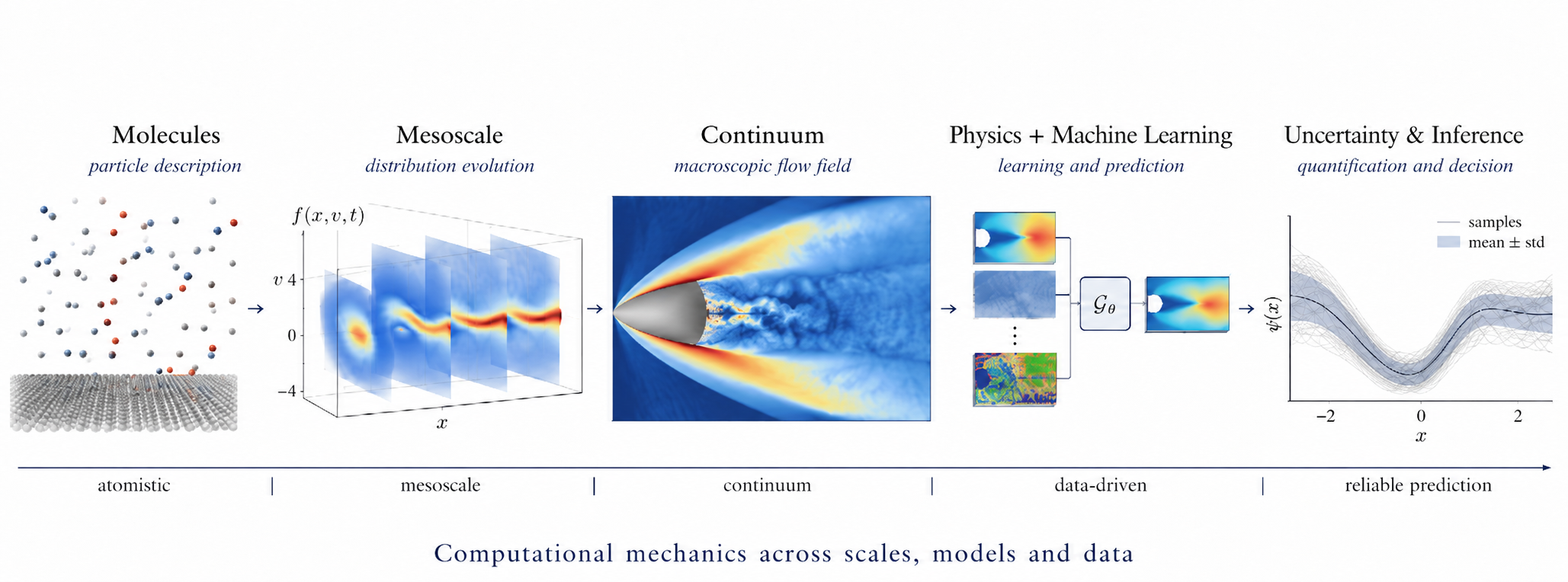
Flows in natural and engineered systems entail cross-scale interactions among molecular motion, interfacial dynamics, macroscopic evolution, and material response. This research direction focuses on non-equilibrium flows, fluid-surface interactions, and multiphysics coupling. Drawing upon mesoscopic theories (including statistical mechanics, gas kinetic theory, and peridynamics), we develop multiscale computational models and high-performance numerical simulation platforms to provide reliable tools for mechanistic analysis and engineering prediction of complex transport phenomena.
2. Uncertainty quantification: from data to knowledge
Model errors, parameter uncertainties, incomplete inputs, and measurement noise are pervasive challenges in simulations and experiments of complex flows. This research direction develops uncertainty quantification methods grounded in probabilistic modeling and Bayesian inference, with particular attention to uncertainty propagation, sensitivity analysis, model calibration, and data assimilation. The goal is to enhance the reliability of scientific inference and engineering prediction in the presence of limited data and incomplete information.
3. Scientific machine learning: from machine to reality
Data in scientific computing are not isolated samples, but are embedded within intrinsic physical structures such as conservation, invariance, symmetry, and entropy dissipation. This research direction is dedicated to designing machine learning models that preserve the structure of non-equilibrium physical systems. We develop unified physical-neural computational approaches, inverse modeling tools, and differentiable programming techniques, aiming to establish scientific machine learning frameworks with interpretability, robustness, and generalization capabilities.
Enrollment
We are looking for highly self-motivated students who are interested in the above research areas to work together : )
Specialties
- Computational Mathematics
- Mechanics
- Materials Engineering
Enrollment Institutions
- University of Chinese Academy of Sciences
- University of Science and Technology of China
- Beijing Normal-Hong Kong Baptist University (co-supervision)
Recruitment
Centre for Interdisciplinary Research in Fluids at Institute of Mechanics, Chinese Academy of Sciences has full-time research positions including professor, associate professor, assistant professor, post-doctoral fellow, and research assistant. We cordially invites young talents with relevant research background to join the research team. Depending on the applicant's specific situation, he/she can apply high-level fellowships from different tiers. Please feel free to contact me for more details.
Service
1. Member of the US-RSE and the RGD NextGen Group
2. Senior Member of the Chinese Society of Astronautics
3. Guest Editor for Journal of Computational and Theoretical Transport, Entropy, Axioms, and Metascience in Aerospace
4. Executive Associate Editor-in-Chief for Theoretical and Applied Mechanics Letters
5. Managing Editor for Results in Physics
6. Associate Editor of the Youth Editorial Board of Physics of Gases
7. Member of the Intelligent Fluid Mechanics Committee, Chinese Aerodynamics Research Society
8. Member of the Academic Degree Committee, Mechanics and Engineering Disciplines, University of Science and Technology of China
9. Member of the Academic Degree Committee, Institute of Mechanics, Chinese Academy of Sciences
10. Executive Assistant to the Director, State Key Laboratory of High Temperature Gas Dynamics
11. Reviewer for Mathematical Reviews, American Mathematical Society
12. Referee for peer-reviewed journals, including Journal of Computational Physics, Journal of Scientific Computing, Journal of Fluid Mechanics, Physics of Fluids, Computer Physics Communications, Communications in Computational Physics, Computers & Fluids, International Journal for Uncertainty Quantification, Journal of Open Source Software, Acta Mechanica Sinica, Theoretical and Applied Mechanics Letters, Advances in Aerodynamics, AIP Advances, IEEE Transactions on Neural Networks and Learning Systems, npj Computational Materials, among others.
Honors
1. Fundamental Research Youth Team Program, Chinese Academy of Sciences, 2024
2. Outstanding Youth Science Fund, National Science Foundation of China, 2023
3. High-level Science and Technology Talent Program, Chinese Academy of Sciences, 2023
4. Young Elite Scientists Sponsorship Program, Chinese Society of Theoretical and Applied Mechanics, 2023
5. Humboldt Fellowship, Alexander von Humboldt Foundation, 2020
6. Physics of Fluids (PoF) Young Researcher Award, American Institute of Physics, 2017
Publication
(Ten representative works selected; see Google Scholar for a complete list)
1. Tianbai Xiao. Solving continuum and rarefied flows using differentiable programming. Journal of Computational Physics, 539: 114224, 2025.
2. Tianbai Xiao and Martin Frank. RelaxNet: A structure-preserving neural network to approximate the Boltzmann collision operator. Journal Computational Physics, 490: 112317, 2023.
3. Tianbai Xiao, Steffen Schotthöfer, and Martin Frank. Predicting continuum breakdown with deep neural networks. Journal Computational Physics, 489: 112278, 2023.
4. Tianbai Xiao, Jonas Kusch, Julian Koellermeier, and Martin Frank. A Flux Reconstruction Stochastic Galerkin Scheme for Hyperbolic Conservation Laws. Journal of Scientific Computing, 95(1): 18, 2023.
5. Tianbai Xiao. A flux reconstruction kinetic scheme for the Boltzmann equation. Journal of Computational Physics, 447: 110689, 2021.
6. Tianbai Xiao and Martin Frank. Using neural networks to accelerate the solution of the Boltzmann equation. Journal of Computational Physics, 443: 110521, 2021.
7. Tianbai Xiao. Kinetic.jl: A portable finite volume toolbox for scientific and neural computing. Journal of Open Source Software, 6(62): 3060, 2021.
8. Tianbai Xiao and Martin Frank. A stochastic kinetic scheme for multi-scale flow transport with uncertainty quantification. Journal of Computational Physics, 437: 110337, 2021.
9. Tianbai Xiao and Martin Frank. A stochastic kinetic scheme for multi-scale plasma transport with uncertainty quantification. Journal of Computational Physics, 432: 110139, 2021.
10. Tianbai Xiao, Chang Liu, Kun Xu, and Qingdong Cai. A velocity-space adaptive unified gas kinetic scheme for continuum and rarefied flows. Journal of Computational Physics, 415: 109535, 2020.
Grants
The research is supported by the German Science Foundation, Alexander von Humboldt Foundation, Hong Kong Research Grants Council, National Natural Science Foundation of China, Ministry of Education of China, etc.
Teaching
Frontiers in Mechanics and Innovative Applications: University of Chinese Academy of Sciences, Spring, 2026
People
The members of the research group (including visiting scholars, postdoctoral fellows, master's and doctoral students, research assistants, and undergraduate students) are listed in the following chronological order:
Visiting Scholars
Jaeyong Lee: Chung-Ang University, 2025
Erkan Oterkus: University of Strathclyde, 2024
Selda Oterkus: University of Strathclyde, 2024
Postdoctoral Research Associates
Shiwei Hu: Institute of Mechanics, Chinese Academy of Sciences, 2023-present
Yong Wang: Institute of Mechanics, Chinese Academy of Sciences, 2024-present
Guan Zhang: Institute of Mechanics, Chinese Academy of Sciences, 2024-present
Yichong Chen: Institute of Mechanics, Chinese Academy of Sciences, 2025-present
Yiming Qi: Institute of Mechanics, Chinese Academy of Sciences, 2025-present
Graduate Students
Mingshuo Han: University of Chinese Academy of Sciences, 2022-2025; University of Science and Technology of China, 2025-present
Longqing Ge: Peking University, 2023-present
Zhiqi Shi: University of Science and Technology of China, 2024-present
Ruhuan Zhao: University of Chinese Academy of Sciences, 2024-present
Zuoxu Li: University of Chinese Academy of Sciences, 2024-present
Xu Wang: University of Chinese Academy of Sciences, 2024-present
Ruijie Li: University of Chinese Academy of Sciences, 2025-present
Weiguang Zheng: University of Chinese Academy of Sciences, 2025-present
Yushi Zhang: Beijing Normal-Hong Kong Baptist University, 2026-present
Minghao Li: University of Science and Technology of China, 2026-present
Yu Lin: University of Chinese Academy of Sciences, 2026-present
Lan Deng: University of Chinese Academy of Sciences, 2026-present
Research Assistants
Charlotte Wedler: Ray effect mitigation in discrete velocity methods for the Boltzmann equation, Karlsruhe Institute of Technology, 2021-2022
Chinmay Patwardhan: Mesh generation techniques for kinetic simulations, Karlsruhe Institute of Technology, 2021
Chloe Griffin: Meta-learning of numerical solution algorithms, Karlsruhe Institute of Technology, 2022
Undergraduates
Martin Sadric: Neural network solvers for differential equations, Karlsruhe Institute of Technology, 2022-2023
Hongxu Ren: Physics-informed neural networks for integral equations, Peking University, 2023
Dong Zhou: Physics-informed neural networks for lattice Boltzmann equations, Chongqing University of Technology, 2023-2024
Weiguang Zheng: Constitutive models of non-equilibrium flows based on mesoscopic mechanics and machine learning, Beihang University, 2024
Jinqiu Deng: Numerical simulation of rarefied gas dynamics, Beihang University, 2024
Jiahao Cai: Numerical simulation of rarefied gas dynamics, Beihang University, 2025
Canyao Sun: Identifications of fluid dynamic equations based on symbolic and sparse regressions, 2025-2026
Alumni
Shuangqing Liu, M.S.: A Study of the Immersed Boundary Method for Non-Equilibrium Flow-Material Interactions, University of Chinese Academy of Sciences, 2023-2026 (First position: Program Manager, Institute of Mechanics, Chinese Academy of Sciences)
Yunpeng Mao, M.S.: Multi-Point Aerodynamic Optimization of Hypersonic Vehicles from Continuous to Rarefied Flow Regimes Based on Surrogate Models, Xi'an Jiaotong University, 2023-2026 (First position: Ph.D. student, Northwestern Polytechnical University)

Photo of group members, Fragrant Hills, September 2024

Photo of group members, Institute of Mechanics, May 2026